
Introduction
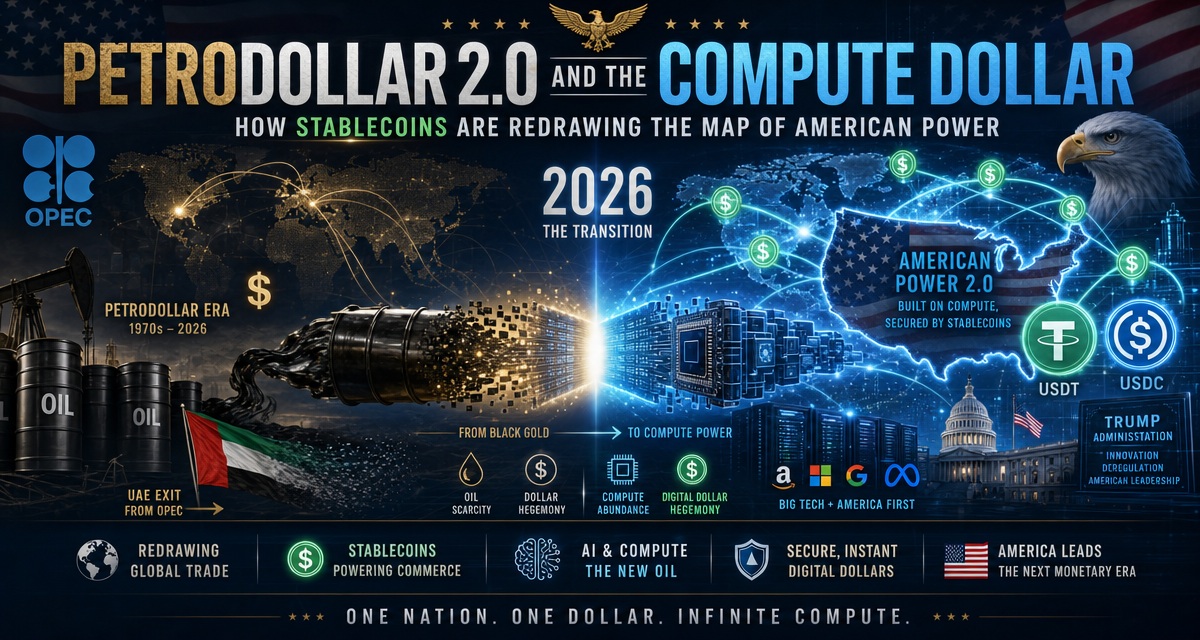
On May 1, 2026, the United Arab Emirates (UAE) formally ended its roughly 59-year membership in the Organization of the Petroleum Exporting Countries (OPEC) — widely described as the most significant rupture in OPEC’s history. Some analysts argue this development introduces a new variable into the petrodollar system that has underpinned dollar dominance since the 1970s. This article examines what the UAE’s OPEC exit actually signifies, the so-called “Compute Dollar” strategy reportedly being considered by U.S. policymakers, and the political and economic alignment that has formed between Big Tech companies and the Trump administration around these developments.
Some interpretations discussed here — particularly any direct causal link between the UAE’s OPEC exit and the construction of a stablecoin-based settlement system — remain analytical speculation rather than confirmed policy. This article distinguishes clearly between verified fact and interpretation throughout.
1. Petrodollar 1.0: The Origins of the 1974 System
The origins of the petrodollar system trace back to the aftermath of the 1971 Nixon Shock and the 1973-74 oil crisis. When President Nixon suspended the dollar’s convertibility into gold in 1971, the dollar became a fiat currency no longer backed by a fixed gold reserve, creating uncertainty about its international standing. To address this, then-Secretary of State Henry Kissinger is widely credited with brokering an arrangement between the United States and Saudi Arabia: Saudi Arabia would price its oil exclusively in dollars, and in exchange, the United States would provide security guarantees. By 1975, every OPEC member had adopted dollar-denominated oil pricing, creating a structure in which global oil demand translated directly into global dollar demand.
This arrangement underpinned the dollar’s reserve currency status for roughly 50 years. However, the dollar’s share of global foreign exchange reserves has declined from approximately 72% in 2001 to roughly 57% as of 2026, a trend some analysts cite as evidence that the petrodollar system’s influence has gradually weakened.
2. The UAE’s OPEC Exit: What Has Been Confirmed
On April 28, 2026, the UAE’s Ministry of Energy announced its withdrawal from OPEC, effective May 1. According to international reporting, the key drivers behind this decision include the following.
Production quota disputes: The Abu Dhabi National Oil Company (ADNOC) has committed approximately $145 billion in investment in its domestic upstream oil sector over the ten years to 2030, with a goal of expanding production capacity to 5 million barrels per day by 2027 — well beyond the production quota OPEC had assigned to the UAE. Years of accumulated friction with Saudi Arabia over production allocation are widely cited as a primary cause of the exit.
Regional political tensions: UAE officials have publicly expressed frustration over having to respond to Iranian missile strikes with relatively limited support from fellow Gulf Cooperation Council (GCC) members, reflecting broader strains in regional political and military coordination.
Relationship with the U.S. Treasury: One notable point of timing is that the UAE’s OPEC exit announcement came just days after U.S. Treasury Secretary Scott Bessent publicly backed an emergency dollar swap line for Abu Dhabi before the Senate. However, international reporting has not established a clear causal link between these two events; this remains an area of analytical speculation based on temporal proximity rather than confirmed cause and effect.
The Strait of Hormuz and Fujairah port: UAE-produced crude — particularly the high-quality Murban grade — can be exported via the port of Fujairah without transiting the Strait of Hormuz, a geographic advantage that has become strategically significant amid 2026 disruptions to Hormuz transit stemming from tensions with Iran.
Taken together, international reporting primarily frames the UAE’s OPEC exit as a consequence of production-quota disputes with Saudi Arabia and regional political tensions. The interpretation that this move represents preparation for a stablecoin-based settlement system is closer to an analytical hypothesis advanced by some commentators rather than an established fact, and this article presents it as a possible scenario rather than a confirmed conclusion.
3. ICE Futures Abu Dhabi (IFAD) and the Murban Crude Futures Market
What is confirmed regarding UAE oil trading is that ICE Futures Abu Dhabi (IFAD), an oil futures exchange based in Abu Dhabi, launched in March 2021. The exchange is operated and majority-owned by Intercontinental Exchange (ICE), a U.S. company, with ADNOC and nine global energy companies — including BP, Shell, and Total — participating as co-shareholders. Notably, ICE is also the parent company of the New York Stock Exchange (NYSE).
Murban crude futures contracts traded on IFAD are physically delivered on a free-on-board (FOB) basis at Fujairah and settled in U.S. dollars. Trading volume on IFAD has grown steadily since its 2021 launch, setting quarterly volume records as recently as the first quarter of 2024.
However, as of June 2026, there is no confirmed official announcement that IFAD has implemented a stablecoin-based settlement system. While some analysts have raised the possibility of such a transition in the future, this remains speculative.
4. The “Compute Dollar”: A Strategy Proposed in a CSIS Report
The second key concept discussed here, the “Compute Dollar,” is confirmed to be a real policy proposal. The Center for Strategic and International Studies (CSIS), a U.S. foreign and security policy think tank, published an analysis in February 2026 titled “Turning the AI Revolution into Dollar Dominance.”
The report’s core proposal is as follows: the United States should leverage its export control authority over advanced semiconductors to require that countries purchasing these chips mandate dollar or dollar-backed stablecoin settlement whenever AI-enabled services built on that compute are exported to third countries. The report explicitly cites the GENIUS Act, the federal stablecoin regulatory framework enacted in July 2025, as the legal foundation for this approach, and recommends that the Commerce Department condition advanced chip export licenses on currency settlement commitments. The report argues that just as the petrodollar system delivered 50 years of monetary advantage, a “compute-dollar” system could offer comparable strategic benefits.
This policy direction aligns with public statements from senior U.S. officials. Vice President JD Vance, speaking at a bitcoin conference in May 2025, stated that stablecoins do not threaten the dollar’s integrity but rather serve as “a force multiplier of our economic might.” Treasury Secretary Scott Bessent has likewise repeatedly stated publicly that stablecoins can be used to reinforce the dollar’s status as the world’s dominant reserve currency.
That said, as of June 2026, there is no confirmed evidence that the specific mechanism proposed in the CSIS report — formally linking semiconductor export licenses to mandatory currency settlement terms — has been adopted as official U.S. government policy. Reporting indicates that existing chip supply agreements with Saudi Arabia and the UAE do not currently contain such explicit currency provisions. In short, the compute dollar is a real and influential policy proposal whose underlying direction aligns with statements from senior administration officials, but it has not yet been codified into law or formally implemented.
5. Big Tech and the Trump Administration: The Politics of Stablecoins
The alliance formed between Big Tech companies and the Trump administration also merits attention. During the 2024 election cycle, Elon Musk was widely reported to have contributed substantial sums to political action committees supporting Trump (exact figures vary across reporting, though they have been described as among the largest in the industry’s history). Some analysts argue this political support was motivated in part by Big Tech’s long-standing interest in financial deregulation.
A confirmed development in this context is the effort by the Department of Government Efficiency (DOGE), with Elon Musk’s involvement, to substantially scale back the Consumer Financial Protection Bureau (CFPB). Beginning in February 2025, the CFPB pursued plans to cut a large share of its roughly 1,700-person workforce — a move that was temporarily blocked by a federal court. Critics, including Senator Elizabeth Warren, publicly raised conflict-of-interest concerns, noting that Musk’s payments venture (X Money) and Tesla’s auto-lending business both fall within the CFPB’s regulatory purview.
Big Tech companies also appear to have pursued differing strategic approaches to stablecoin regulation. PayPal’s PYUSD stablecoin was designed to be fully backed by U.S. Treasury securities and cash equivalents, operating under the oversight of the New York State Department of Financial Services (NYDFS) and the Office of the Comptroller of the Currency (OCC). This can be understood, by comparison, as a strategy of working within the existing financial regulatory framework — by building in Treasury-backed collateral — in contrast to Meta’s (then-Facebook) 2019 “Libra” project, which was ultimately abandoned after facing strong opposition from financial regulators worldwide.
Conclusion
Petrodollar 2.0 and the Compute Dollar are concepts situated within a broader effort by the United States to redesign its existing currency-hegemony structures for the 21st century using digital asset technology. That said, it is worth reiterating that the interpretation linking the UAE’s OPEC exit directly to the construction of a stablecoin settlement system remains an unconfirmed hypothesis, and the compute dollar itself remains at the stage of a CSIS policy proposal. Future developments in U.S. administration policy and shifts in the monetary strategies of Gulf states, including the UAE, warrant continued attention.
This article is provided for informational purposes only and does not constitute investment advice or a recommendation. Any decisions regarding related assets or policies should be made independently, following careful and thorough research.
This article was prepared based on publicly available sources, including reporting from CSIS (Center for Strategic and International Studies), Fortune, Wood Mackenzie, Asia Times, Intercontinental Exchange (ICE), CNBC, and NPR. Analytical interpretations have been explicitly attributed to market commentary rather than presented as confirmed fact.