
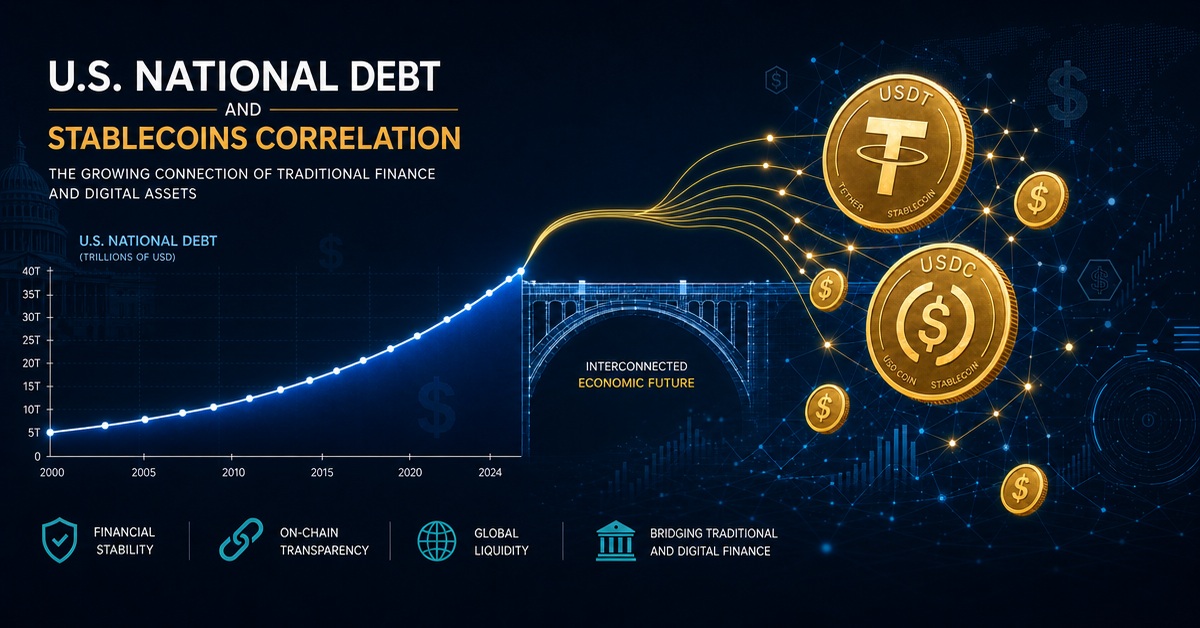
The Weight of $39 Trillion
In 2026, U.S. federal debt has surpassed roughly $39 trillion — about 123% of GDP, entering the highest range since the immediate aftermath of World War II. The bigger problem is the pace. The debt is growing by more than $7 billion a day on average, and net interest costs have nearly tripled over the past five years. The Congressional Budget Office (CBO) projects that interest will rise from about 13.9% of total federal outlays in fiscal year 2026 to 14.5% by 2028. In short, the United States is edging closer to a structure of “borrowing more to pay off what it already owes.”
Someone has to keep buying this enormous pile of debt for the system to hold. Yet foreign central banks — the traditional heavyweight buyers — have seen their share of U.S. Treasury holdings stagnate and decline. The new candidate stepping in to fill that gap is the “stablecoin.”
How Stablecoins Became a “Treasury Demand Engine”
A stablecoin is a digital token pegged 1:1 to a fiat currency such as the U.S. dollar. The GENIUS Act, enacted on July 18, 2025, provided this market with a federal rulebook. Its core provision requires issuers to hold reserves equal to the full value of tokens issued — in cash, or in safe assets such as short-term Treasury bills (T-bills) maturing in 93 days or less and repurchase agreements (repos).
The implication is simple but powerful. If global demand for digital dollars rises by $10 billion, issuers must almost automatically buy roughly $10 billion of short-term Treasuries. This creates a mechanical, apolitical wave of buying that responds purely to dollar demand — regardless of investor sentiment or what the Federal Reserve says. In fact, the largest issuer, Tether (USDT), holds about $113 billion in Treasury exposure, a sum that, on a single-entity basis, rivals the world’s 18th-largest sovereign holder of U.S. Treasuries.
The Purpose: The Link to the Debt
Here the correlation between the debt and stablecoins becomes clear. U.S. Treasury Secretary Scott Bessent has publicly argued that stablecoins will drive a surge in demand for Treasuries, which in turn could lower the government’s borrowing costs and help rein in the national debt. He projects that the stablecoin market — currently around $230 billion — could exceed $2 trillion by 2028, a roughly tenfold growth scenario.
In essence, Washington’s strategic intent reads as follows. First, create a new structural source of demand to absorb the surge in short-term Treasury issuance. Second, by letting billions of people worldwide hold and transact in “digital dollars” without even needing a bank account, extend dollar hegemony into the digital realm. It is a design aimed at two birds — debt management and reserve-currency defense — with one stone. This is why some analysts liken stablecoins to “digital war bonds.”
It Is Not All Upside
That said, cautionary views clearly exist. The Brookings Institution and others point out that stablecoins may merely reallocate existing money rather than increase net demand. If money simply migrates from bank deposits or money market funds (MMFs) into stablecoins, the net increase in Treasury demand could be smaller than hoped, partly offset by a loss of seigniorage (the profit from issuing currency).
The bigger worry is “run” risk. If a large stablecoin faces a wave of mass redemptions, the issuer must sell off its reserve T-bills all at once, which then spills over into selling pressure on the Treasury market. The very mechanism propping up public finances could, paradoxically, become the epicenter of a market shock — a double-edged sword.
So How Should Individuals Respond?
In this structure, the key point for individuals to remember is a single one: the more debt a government carries, the more one must prepare for the possibility of gradual currency debasement (inflation). Below are the commonly cited principles for protecting and growing wealth.
- Diversify first. Don’t pile into a single asset class; spread risk across equities, bonds, real assets, and cash-equivalents.
- Include some inflation hedges. Treasury Inflation-Protected Securities (TIPS), gold and commodities, and quality real estate are frequently cited as assets that hold up during periods of currency depreciation.
- Hold productive assets. Over the long run, shares of quality companies with cash flow and pricing power have been a core source of returns that outpace inflation.
- Approach digital assets “only as far as you understand them.” Stablecoins and cryptocurrencies carry clear volatility, de-peg, and regulatory risks, so a small, diversified exposure within what you can afford to lose is advisable.
- Manage debt and emergency liquidity. Reduce high-interest debt, and secure a cash buffer of three to six months of living expenses to build the resilience to withstand shocks.
Closing Thoughts
Stablecoins are not merely “coins” — they are closer to a new Treasury-demand infrastructure that the United States has engineered for an era of $39 trillion in debt. This sweeping trend carries opportunity and risk in equal measure. The individual’s task is to understand the trend accurately and, rather than betting on one side, to protect their wealth with the fundamentals of diversification and inflation preparedness.
Disclaimer: This article is a general analysis for informational purposes only and does not constitute investment advice or financial or tax counsel. All investment decisions and their outcomes are the sole responsibility of the investor; for specific decisions, please consult a qualified professional.
Sources: U.S. Congress Joint Economic Committee (JEC) Monthly Debt Update; U.S. Treasury Fiscal Data; USAFacts; Congressional Budget Office (CBO); Congress.gov (S.1582, GENIUS Act); the Brookings Institution; Goldman Sachs research; and public remarks and congressional testimony by Treasury Secretary Scott Bessent (2025–2026).