
Introduction
Recent U.S. government restrictions on access to Anthropic’s most advanced AI models have drawn significant market attention. Some analysts argue this development is not confined to the AI industry alone, but is connected to broader U.S. national security strategy, efforts to extend dollar hegemony, and even the digital asset market. This article examines how the United States appears to be incorporating semiconductors and AI computing power into a new form of dollar-backed financial architecture, and the role private capital coalitions — led by BlackRock — are playing in that process.
The “dollarization of AI compute” strategy discussed below remains an evolving policy trend, and some of the interpretations presented here reflect analytical commentary from market observers rather than confirmed government policy.
1. Expanding the Collateral Strategy: From Gold and Real Estate to Bitcoin and AI Compute
The United States is pursuing several parallel strategies aimed at extending dollar hegemony through physical or quasi-physical collateral. These include revaluing the Federal Reserve’s gold certificate holdings to reflect current market prices, issuing bonds backed by government-owned real estate assets, and establishing a Strategic Bitcoin Reserve built from forfeited assets. Each of these can be interpreted as an attempt to secure tangible or asset-backed collateral capable of supporting continued Treasury debt issuance.
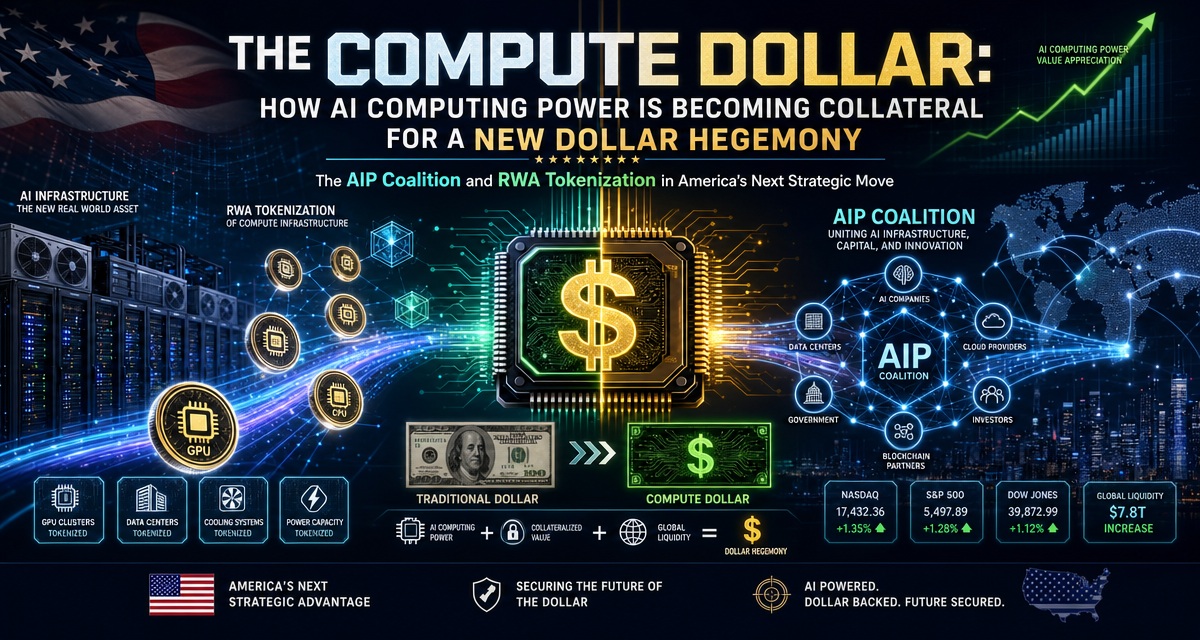
A more recent and increasingly prominent thread in this strategy involves treating semiconductors and AI computing power as a new category of collateral asset. Semiconductors are physical goods, and while AI computing power itself is intangible, it is fundamentally grounded in physical infrastructure — data centers and graphics processing units (GPUs) — giving it characteristics similar to a real-world asset.
A fundamental constraint of the traditional gold-backed currency model is that the finite supply of gold inherently limits the scope of monetary issuance. This has driven proposals to convert gold certificates into digital assets through Real World Asset (RWA) tokenization, enabling broader market circulation. By contrast, the AI semiconductor and computing power market is notable for growing rapidly without requiring direct financial engineering intervention from Wall Street. As competition to build AI data centers accelerates and demand for NVIDIA’s advanced chips continues to outstrip supply, this market’s collateral value appears to expand organically.
In this context, some analysts suggest that incorporating AI compute into a controllable, dollar-linked framework could offer the U.S. administration a more immediate and dynamic path to collateral expansion compared to the relatively longer-term strategies of gold revaluation or Bitcoin accumulation. This remains an analytical interpretation, however; there is no confirmed evidence that the U.S. government has formally adopted this as an explicit policy objective.
2. The AIP Coalition: BlackRock, Microsoft, NVIDIA, xAI, and MGX
A key development worth noting is the rise of the AI Infrastructure Partnership (AIP), a private capital coalition focused on AI infrastructure investment. AIP was established in September 2024 by BlackRock, Global Infrastructure Partners (GIP, a BlackRock affiliate), Microsoft, NVIDIA, and the UAE sovereign wealth fund MGX. In March 2025, Elon Musk’s xAI joined the partnership, with the Kuwait Investment Authority and Temasek also participating as key financial backers.
MGX is an AI-focused sovereign investment fund that holds the UAE’s state-backed AI company G42 as a subsidiary, and has rapidly expanded its influence in the global AI infrastructure market. AIP was launched with a goal of mobilizing approximately $30 billion in equity capital, with the potential to scale up to $100 billion when including debt financing. The combined market capitalization of AIP’s member companies has been reported to exceed $30 trillion.
AIP’s first major investment was the acquisition of Aligned Data Centers, announced in October 2025. The consortium acquired 100% of the equity in Aligned — previously held by Macquarie Asset Management — in a deal valued at approximately $40 billion, marking the largest data center acquisition to date. This positions AIP to directly control significant data center and cloud infrastructure capacity across North and South America.
3. The Compute Dollar System vs. the Petrodollar System
One key distinction between an AI-compute-based hegemonic strategy and the traditional petrodollar system lies in the number of critical actors involved in the respective supply chains. The oil market historically involved a wide range of participants — Saudi Arabia and other OPEC members, as well as non-OPEC producers and Russia — making it, in practice, difficult for the United States to exert complete control.
By contrast, the advanced AI semiconductor supply chain is concentrated among a relatively small number of key companies: NVIDIA in chip design, Samsung Electronics and SK Hynix in memory semiconductors, and TSMC in foundry manufacturing. Because NVIDIA is a U.S. company, Samsung and SK Hynix are based in South Korea — a close U.S. ally — and Taiwan, home to TSMC, maintains a deep security dependency on the United States, some analysts argue this creates a structure in which Washington can exert outsized influence over the entire supply chain through a small number of key relationships.
That said, controlling the physical distribution of semiconductors is a fundamentally different challenge from monitoring and controlling which specific cloud services are being delivered to which customers through data centers. The latter requires direct visibility into service usage, which remains a more technically and institutionally complex problem.
4. RWA Tokenization and the Modularization of Compute: BlackRock’s Strategy
This is where BlackRock’s role becomes particularly notable. According to industry analysts, the core of BlackRock’s strategy involves modularizing AI computing power — specifically, GPU operating hours — into standardized units that can be issued as RWA tokens. Under this model, access rights to a defined block of GPU compute time would be tokenized and made purchasable using stablecoins. This remains a largely conceptual model rather than a fully commercialized product, and no official announcement confirming a specific implementation has been identified.
If realized, this structure could directly link access to AI data center compute with stablecoin-based settlement systems — a development that would align closely with the broader digital asset policy agenda the U.S. is pursuing. The Digital Asset Market CLARITY Act, which cleared the Senate Banking Committee on May 14, 2026, includes provisions (Sections 401 and 402) that would formally permit banks and financial institutions to handle RWA products. Senator Elizabeth Warren attempted to strip these provisions from the bill, but the amendment failed by an 11-13 vote. Senator Cynthia Lummis (R-WY) is widely reported to have been the central negotiator behind these provisions.
These sections matter because, under the traditional separation of banking and commerce embedded in the Bank Holding Company Act, financial institutions were generally barred from direct investment in physical assets. By classifying RWAs as “financialized real-world assets” rather than direct physical holdings, the legislation creates a legal pathway for banks and asset managers to engage with this asset class. As of June 2026, the CLARITY Act awaits a full Senate floor vote, which requires at least 60 votes to overcome a filibuster.
5. The Link Between Stablecoins and the Treasury Market
For the U.S. government, growth in the RWA and stablecoin markets is directly tied to expanding demand for Treasury securities. Under the GENIUS Act, enacted in 2025 to regulate stablecoins, qualified stablecoin issuers are required to purchase short-term Treasury securities in real time, in amounts corresponding to their issuance volume. This creates a structural mechanism whereby growth in the stablecoin market automatically generates additional demand for short-term U.S. government debt.
In this context, if RWA businesses (such as those pursued by BlackRock) and stablecoin issuance businesses (such as those pursued by Circle) become linked on-chain, the U.S. administration could gain a more efficient market-based channel for absorbing roughly $40 trillion in national debt. This dynamic gives the Trump administration a clear policy incentive to support the growth of the RWA and stablecoin industries.
At the same time, this process has surfaced tension between traditional commercial and investment banks and newer digital-asset-native players — including BlackRock’s RWA business, Circle, and Elon Musk’s efforts around stablecoins through xAI. Notably, as of June 2026, no major Big Tech company — including Google or Meta (Facebook) — has formally launched or commercialized its own stablecoin. Some analysts attribute this less to technical limitations than to an institutional power struggle between incumbent financial regulators and new market entrants.
6. Implications for South Korea and Other U.S. Allies
These developments carry significant implications for South Korea and other U.S. allies. As reliance on U.S.-operated AI cloud services deepens, concerns have been raised about the possibility that the U.S. government could request access to information such as data traffic logs or service usage records — raising questions that touch on national data sovereignty.
In response, South Korea and several other countries are pursuing the development of domestic AI data center infrastructure and independent AI capabilities. However, while companies such as Samsung Electronics and SK Hynix hold genuine leverage in the memory semiconductor segment, complete independence from U.S. technology — particularly in advanced GPU design — remains a practical constraint. In this environment, leveraging core national assets as negotiating tools to secure the most favorable possible terms is increasingly framed as a realistic strategic option for governments navigating this dependency.
Conclusion
The U.S. effort to incorporate semiconductors and AI computing power as a new form of strategic collateral bears structural similarities to the historical pattern by which the United States sustained dollar hegemony through gold and, later, oil. Much of this analysis, however, concerns an evolving policy and industry landscape, and outcomes will depend on factors including the final disposition of the CLARITY Act, the degree to which RWA markets become formally institutionalized, and the future trajectory of private capital coalitions such as AIP.
This article is provided for informational purposes only and does not constitute investment advice or a recommendation. Investment decisions related to these assets and industries should be made independently, following careful and thorough research.
This article was prepared based on publicly available sources, including press releases and reporting from BlackRock, Global Infrastructure Partners (GIP), CoinDesk, Ledger Insights, and The Block. Analytical interpretations have been explicitly attributed to market commentary rather than presented as confirmed fact.