
Introduction / A New Monetary and Fiscal Design for the Warsh-Bessent Era
In May 2026, Kevin Warsh succeeded Jerome Powell as the 17th Chair of the Federal Reserve. Warsh had publicly advocated for a “New Treasury-Fed Accord” well before his confirmation, reigniting debate over the future direction of Fed policy. This article examines two distinct but related threads: first, the historical context of the 1951 Treasury-Fed Accord and the gold certificate revaluation scenario currently being discussed as a potential fiscal financing mechanism; second, the U.S. Department of Defense’s emerging treatment of Bitcoin as a national cybersecurity asset.
Some of what follows is grounded in confirmed, publicly reported fact. Other elements remain speculative scenarios discussed by market commentators rather than confirmed policy. This article distinguishes clearly between the two.
1. The 1951 Treasury-Fed Accord: The Origin of Fed Independence
To understand the current debate over Fed independence, one must return to 1951. During World War II and the Korean War, the U.S. Treasury needed to issue large volumes of government debt to finance the war effort. The Federal Reserve, in turn, pegged interest rates on that debt and absorbed whatever the market would not buy — effectively functioning as an extension of the Treasury’s financing operations.
Once the war ended, inflation accelerated sharply. Consumer Price Index (CPI) inflation reached 17.6% between June 1946 and June 1947, and 9.5% the following year. By early 1951, annualized CPI inflation had reached roughly 21%. Tension grew between the Fed and the Truman administration, as Fed officials increasingly believed that continuing the rate peg would entrench runaway inflation.
On March 4, 1951, the Treasury and the Fed issued a joint statement announcing they had reached “full accord with respect to debt management and monetary policies… to assure the successful financing of the Government’s requirements and, at the same time, to minimize monetization of the public debt.” This Treasury-Fed Accord is widely regarded as the foundation of the modern, independent Federal Reserve, allowing the central bank — under then-Chairman William McChesney Martin — to pursue monetary policy independent of Treasury debt-management needs.
It is worth noting that the Accord was an institutional understanding rather than a binding legal agreement. Decades later, during the 2008 financial crisis and the COVID-19 pandemic, the Fed again purchased large volumes of Treasury securities and mortgage-backed securities (quantitative easing), prompting renewed debate within academic and Fed circles over whether the spirit of the 1951 Accord had been eroded.
2. Kevin Warsh’s “New Accord” and the Push to Shrink the Fed’s Balance Sheet
Kevin Warsh served as a Federal Reserve governor from 2006 to 2011, working closely with then-Chair Ben Bernanke during the 2008 financial crisis on matters including the sale of Bear Stearns, the collapse of Lehman Brothers, and the AIG bailout. He later resigned from the Board, citing concerns over the long-term inflationary risks of the Fed’s bond-buying programs, and spent the following years at Stanford’s Hoover Institution.
In an April 2025 speech to the G-30, Warsh criticized what he described as the Fed’s “forays far afield — for all seasons and all reasons,” arguing this had produced systematic errors in monetary policy conduct. He explicitly argued that “the spirit of the Treasury-Federal Reserve Accord of 1951 is at odds with recent practice,” and in a July 2025 CNBC interview reiterated the need for “a new Treasury-Fed accord, like we did in 1951.”
President Trump nominated Warsh to chair the Federal Reserve on January 30, 2026. On May 13, 2026, the Senate confirmed him by a 54-45 vote — the closest confirmation margin for a Fed chair in modern history. Warsh was sworn in on May 22, 2026, and has since called for “regime change” at the Fed, signaling intent to shrink the institution’s balance sheet and streamline its internal operations.
The core of Warsh’s proposed new accord is that the Fed should step back from functioning as an unlimited buyer of Treasury debt or gold certificates, refocusing instead purely on interest rate policy and price stability — a shift that would, in principle, strengthen the Fed’s independence and neutrality.
However, the specific mechanism often discussed alongside this — revaluing the Fed’s gold certificate holdings to current market prices as a way to generate fiscal resources for the Treasury — remains, as of June 2026, an unconfirmed scenario discussed by market commentators rather than an officially adopted policy. Notably, six former Federal Reserve officials have publicly described Warsh’s proposed accord as “unclear or confusing.”
The Accounting Mechanics of Gold Certificate Revaluation
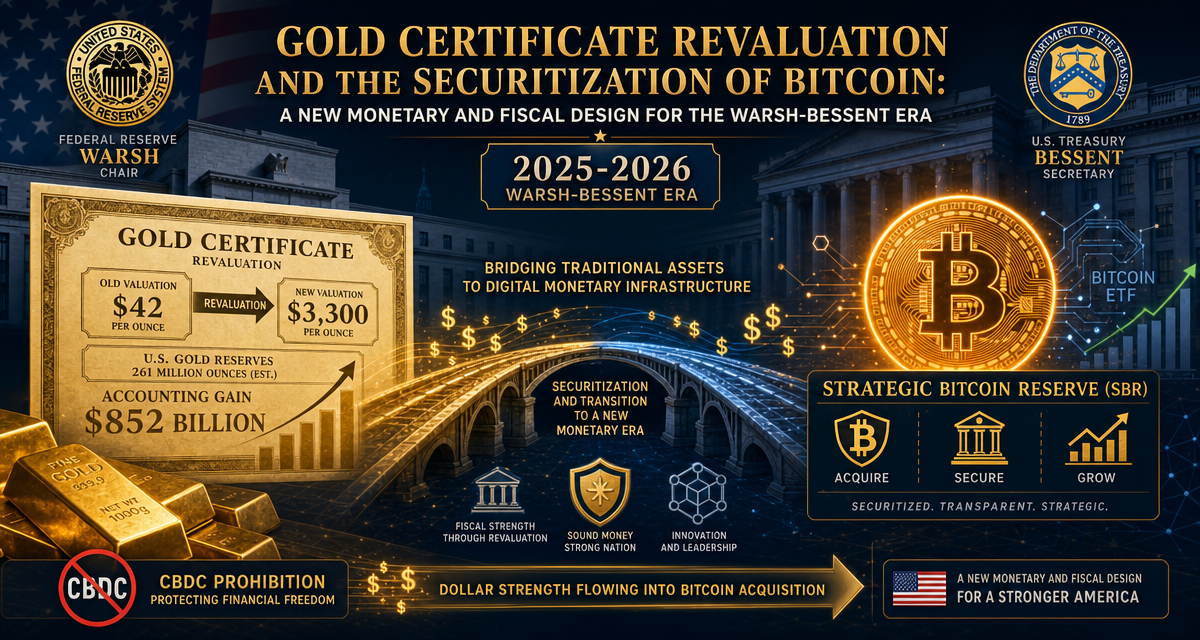
To clarify the underlying mechanism: the United States’ gold holdings are legally owned by the Treasury, while the Fed holds a corresponding “gold certificate” as an asset and has issued dollars to the Treasury against it. Since 1973, gold certificates have been carried on the Fed’s balance sheet at the statutory price of $42.22 per troy ounce — far below the prevailing market price (which has exceeded $3,000 per ounce in 2026).
In theory, revaluing the certificates to reflect current market prices would increase the Fed’s gold certificate asset and a corresponding dollar liability simultaneously, preserving balance-sheet equilibrium. The open question is how the resulting fiscal headroom would be used. This creates a structural tension: Warsh’s stated goal of balance-sheet reduction conflicts with any mechanism that increases recorded assets. Market commentary has floated possible resolutions — such as using the revaluation gain to directly retire existing Treasury debt, or selling the revalued certificates (potentially structured as tokenized real-world assets, or RWAs) to private markets — sometimes linked to pending RWA-related legislation. These remain speculative interpretations rather than confirmed policy design.
Readers should treat this discussion as one of several scenarios being floated amid ongoing negotiation and institutional design, not as settled policy.
3. Bitcoin as a National Security Asset: What Has Been Confirmed
The second thread concerns the U.S. Department of Defense (now referred to as the Department of War) increasingly treating Bitcoin not merely as a speculative financial asset, but as a cybersecurity and national security asset. Unlike the gold certificate scenario above, this is not speculation — it was confirmed in testimony before the U.S. House Armed Services Committee on April 30, 2026.
What Was Said in Congressional Testimony
On April 30, 2026, Secretary of Defense (now Secretary of War) Pete Hegseth testified before the House Armed Services Committee in response to questioning from Texas Representative Lance Gooden. Hegseth stated, “I am a long enthusiast of Bitcoin and crypto potential,” and added that “a lot of the things we are doing, enabling it or defeating it, are classified efforts that are ongoing inside our department, which do provide us a lot of leverage in a lot of different scenarios.”
At the same hearing, Admiral Samuel J. Paparo Jr., commander of U.S. Indo-Pacific Command (INDOPACOM), testified in response to Rep. Gooden’s questions: “Presently, we have a node on the Bitcoin network right now. We’re not mining Bitcoin. We’re using it to monitor, and we’re doing a number of operational tests to secure and protect networks using the Bitcoin protocol.” Paparo characterized Bitcoin as a computer-science system grounded in cryptography, blockchain, and proof-of-work, noting its potential to impose real, quantifiable costs within cybersecurity contexts.
Hegseth further framed Bitcoin as a potential counterweight to what he described as China’s model of digital control, tying the technology to broader geopolitical competition. Observers have characterized these statements as marking a meaningful shift in how senior U.S. defense officials discuss Bitcoin — moving away from a narrow focus on illicit-finance risk and toward viewing it as a strategic and technical instrument.
Policy Context
This shift did not emerge in isolation. In 2025, the Trump administration signed an executive order establishing a Strategic Bitcoin Reserve, seeded with approximately 200,000 government-held bitcoins obtained through forfeitures. The fiscal year 2026 National Defense Authorization Act (NDAA) allocated roughly $15.1 billion to cyberspace activities, a 4.1% increase over the prior year. The April 2026 testimony can reasonably be read as part of the broader national-security architecture being constructed atop this policy foundation.
That said, Secretary Hegseth explicitly characterized the specific programs involving Bitcoin as classified. As of June 2026, it remains unconfirmed exactly what projects are underway, or whether Bitcoin will be formally codified as a recognized cybersecurity asset class through legislation. Further congressional deliberation and potential legislative action bear watching.
4. Where the Two Threads Intersect
On the surface, gold certificate revaluation and Bitcoin’s security-asset designation belong to different policy domains. Yet both reflect a broader pattern: the U.S. government appears to be re-defining both a legacy asset (gold) and an emergent digital asset (Bitcoin) as instruments of fiscal and national-security strategy, respectively. Warsh’s effort to re-establish Fed independence and the Pentagon’s effort to elevate Bitcoin to a security asset are unfolding in separate institutions, but both can be read as expressions of a similar underlying logic — repositioning assets once viewed primarily as market instruments into the category of strategic national assets.
This observation is an analytical interpretation, however, and no official evidence currently confirms that the two policy tracks were designed in coordination with one another.
Conclusion
The new Fed-Treasury accord and the gold certificate revaluation scenario remain works in progress; further analysis will be warranted once concrete terms between Chair Warsh and Treasury Secretary Bessent become public. The Pentagon’s treatment of Bitcoin as a security asset, by contrast, has been partially confirmed through congressional testimony — though the most significant operational details remain classified, limiting the full picture available to outside observers.
Readers should monitor how these policy developments may affect the prices of gold, Bitcoin, and related assets. However, this article is provided for informational purposes only and does not constitute investment advice or a recommendation. Any investment decisions regarding these assets should be made independently, after careful and thorough research.
This article was prepared based on publicly available sources, including Federal Reserve History, the Brookings Institution, the Federal Reserve Bank of Richmond, Wikipedia, public congressional testimony records, and news reporting. Scenario-based content has been explicitly identified as speculative commentary rather than confirmed policy.