
Introduction
One name keeps coming up whenever crypto market weakness needs an explanation: the Digital Asset Market CLARITY Act (H.R. 3633). The bill passed the House by a vote of 294 to 134 on July 17, 2025, yet nearly a year later it is still awaiting a final vote in the Senate. Recently, the House has begun revisiting the same bill it already passed — a move that might look confusing on the surface, but a closer look at the legislative process suggests it may actually signal the bill is approaching its final stages. This article lays out, based on verified reporting, where the CLARITY Act currently stands, what is blocking its passage, and what changes might follow if it becomes law.
1. The July 17 House Hearing: Why New York?
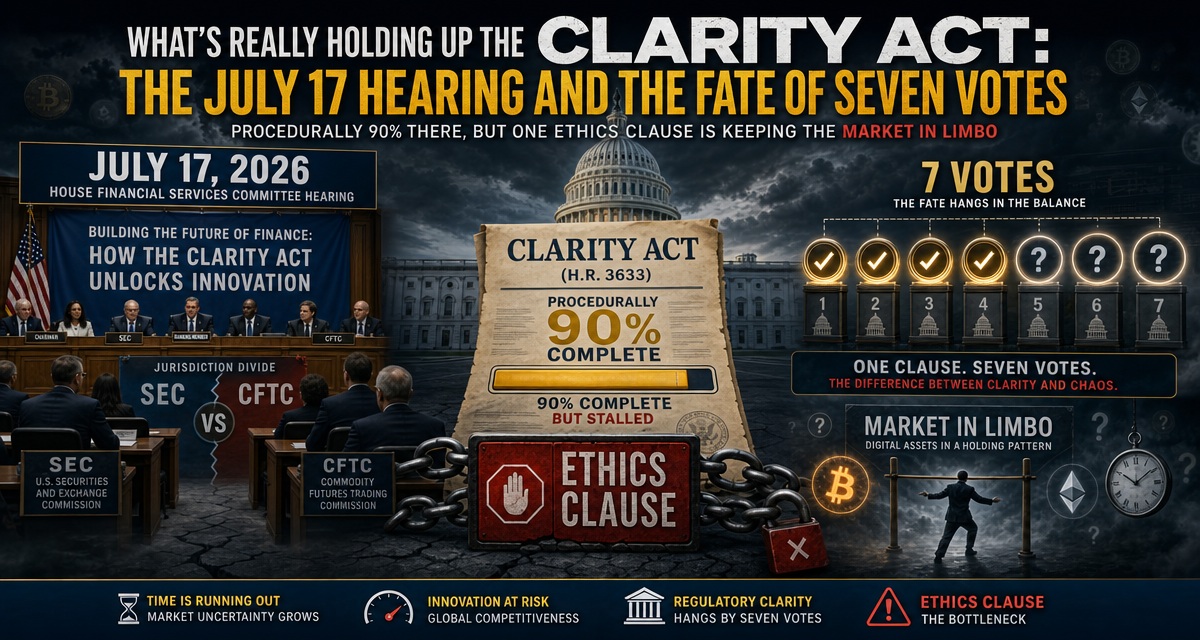
The U.S. House Financial Services Committee has announced a field hearing on the CLARITY Act in New York City on July 17, 2026. The hearing is formally titled “Building the Future of Finance: How the CLARITY Act Unlocks Innovation,” and was announced by Committee Chairman French Hill.
The date is not a coincidence. Exactly one year earlier, on July 17, 2025, the House held what became known as “Crypto Week,” passing the CLARITY Act alongside the GENIUS Act (the stablecoin regulatory framework) and legislation banning the Federal Reserve from issuing a central bank digital currency (CBDC). The choice of New York over Washington is also symbolic. Witnesses are expected to include representatives from the New York Stock Exchange, blockchain infrastructure firms such as Avalanche, and executives from stablecoin issuers including Circle.
That said, the practical legislative weight of this hearing warrants a careful read. Some outlets have noted that, since the House already passed its own version of the bill last year, this hearing functions more as a messaging exercise than as a legislative gate — a signal to the Senate that the House stands ready to act quickly once the Senate moves.
2. Why the House Must Revisit a Bill It Already Passed
For a bill to reach the president’s desk in the United States, the House and Senate must pass identical text. The Senate, however, did not simply adopt the House’s original bill.
On May 14, 2026, the Senate Banking Committee advanced the CLARITY Act by a 15-9 vote, with all 13 Republicans joined by two Democrats, Senators Ruben Gallego and Angela Alsobrooks. Both Democrats made clear that their committee votes did not guarantee support on the Senate floor. On June 1, 2026, a new version of the Senate bill was published and placed on the Senate Legislative Calendar (Calendar No. 423), making it formally eligible for a floor vote at any time.
The complication is that the Senate’s substitute text diverges substantially from the House’s original bill. The length alone reflects this: reporting indicates the bill’s text now runs to roughly 594 pages, with new classifications for network tokens and “ancillary assets” that were absent from the House version. Because U.S. legislative procedure requires identical House and Senate text before a bill can reach the president, the House must review and accept (or reject) the Senate’s revisions. The July 17 hearing can be understood as preparatory groundwork for that eventual reconciliation process.
3. Fast Track vs. Slow Track: Two Paths Through Congress
Once the Senate passes its version, the process can follow one of two broad paths.
The fast path (concurrence): If the Senate’s revised bill stays sufficiently close to the House’s original text, the House can simply adopt the Senate version in a single vote, without convening a formal conference. This path runs: Senate passage → House concurrence → presidential signature, a relatively swift sequence.
The slow path (conference committee): If the two chambers’ texts diverge too much, House and Senate negotiators must form a conference committee to reconcile differences, after which both chambers must vote again on the resulting compromise — a process that can consume considerable additional time.
According to reporting, Chairman French Hill and Representative Tom Emmer, who have championed the bill, are aiming for the fast path. On June 18, 2026, Representative Dusty Johnson, who chairs the House Agriculture Committee’s digital assets subcommittee, stated that if the Senate sends its version over before the August recess, the House would move to pass it without convening a conference. This reflects a strategy of compressing the remaining timeline to reach a presidential signature as quickly as possible.
4. Time Is the Real Constraint: The August Recess Deadline
Earlier in the process, some advocates floated July 4, 2026 — the United States’ Independence Day — as a target date for passage, with White House crypto adviser Patrick Witt describing it as a fitting “250th birthday present” for the nation. That timeline, however, is now widely viewed as unrealistic given how the schedule has unfolded. Most reporting now points to the August congressional recess as the practical deadline. Senator Cynthia Lummis and other key proponents appear to be treating the period before the August recess as the realistic window for a floor vote.
The stakes of this deadline are significant. If the bill slips past the August recess, the country moves into midterm election season, a period in which securing Democratic cooperation could become considerably more difficult. Some analysts have warned that missing this window could delay comprehensive crypto legislation for years — with some pointing to as late as 2030 as a worst-case scenario.
5. The Shifting Center of Debate: From Stablecoin Yield to Ethics
The central point of contention surrounding the bill has shifted over time.
The earlier flashpoint — stablecoin yield: Concerns arose that allowing stablecoin issuers to pay interest-like rewards to holders could siphon deposit customers away from banks, prompting strong pushback from banking industry groups. This issue appears to have been substantially resolved through a compromise crafted by Senators Thom Tillis and Angela Alsobrooks on the Senate Banking Committee — banning yield on simple holdings while leaving room for rewards tied to active use of stablecoins. Even so, some bank executives, including JPMorgan CEO Jamie Dimon, have continued to publicly criticize the compromise.
The current flashpoint — government ethics and conflict-of-interest provisions: Reporting suggests that a substantial majority of the bill’s content (some industry participants put the figure at 80-85%) has already been agreed upon, but the final knot remains untied. At the core of the dispute is how far to limit senior officials — including the president — from personally profiting from cryptocurrency activity while in office.
A closed-door ethics negotiation on June 9, 2026, involving Senators Kirsten Gillibrand, Ruben Gallego, Bernie Moreno, and Cynthia Lummis, along with Patrick Witt, executive director of the President’s Council of Advisers on Digital Assets, reportedly broke down without agreement. The central sticking point was enforcement authority: a compromise that would have empowered state attorneys general to bring civil actions against the Department of Justice over enforcement failures was withdrawn by Republicans and the White House, who instead proposed narrowing enforcement authority to the U.S. Attorney General — a presidentially appointed position. Democrats reportedly rejected this as “functionally circular,” given that the Attorney General serves at the president’s discretion.
Much of this tension is widely understood to stem from the Trump family’s roughly $2.3 billion in crypto-related holdings, according to multiple reports. Witt has publicly stated that the administration will accept ethics rules that apply “across the board, from the president all the way down to the brand new intern on Capitol Hill,” but will reject any language singling out a specific individual or family. Senator Elizabeth Warren has argued that the latest draft contains no provisions addressing the crypto conflict-of-interest issue at all, while Senator Adam Schiff has expressed considerable skepticism that any deal Witt reaches could survive internal White House review given the president’s direct financial exposure.
6. The Math of Seven Votes: Whose Hands Decide the Outcome
To clear the Senate’s 60-vote filibuster threshold, at least seven Democratic votes are needed even if all 53 Republicans vote in favor. The Democratic senators currently drawing the most attention include:
- Ruben Gallego and Angela Alsobrooks: Both voted yes in committee but have made clear that floor support is conditional on a satisfactory ethics agreement.
- Mark Warner: Has raised concerns regarding anti-money-laundering and national security provisions, particularly Section 604 (related to the Blockchain Regulatory Certainty Act).
- Kirsten Gillibrand: Has stated unequivocally that there is no path to 60 votes without an ethics agreement.
The three conditions these senators consistently emphasize are consumer protection, anti-money-laundering safeguards, and government ethics. Procedurally, the bill has cleared committee and been placed on the floor calendar — but its actual fate now rests with roughly seven Democratic senators.
7. The Case for Passage: A $150 Million Enforcement Fund
Supporters have also worked to strengthen the public case for passage. On June 16, 2026, Senator Lummis stated on social media that the CLARITY Act includes a $150 million law enforcement allocation aimed at combating digital asset crime. This funding is described as supporting the Treasury’s Financial Crimes Enforcement Network (FinCEN) in expanding anti-money-laundering infrastructure, analyzing suspicious activity reports, and enhancing tools to trace cross-chain “mixing” used to launder illicit funds.
It is worth noting that this $150 million figure has been reported by some outlets as appearing primarily in industry advocacy materials rather than in the Senate Banking Committee’s official fact sheets. Lummis has cited FBI data indicating Americans lost approximately $9.3 billion to crypto-related internet crime in 2024, with victims aged 60 and older separately accounting for roughly $5 billion in online fraud losses. These figures appear central to a messaging strategy aimed at reframing the CLARITY Act not as deregulation, but as a bill that strengthens enforcement and consumer protection.
8. How Passage Odds Have Shifted Over Time
Market-based forecasts of the bill’s passage probability have fluctuated considerably. Crypto research firm Galaxy Research at one point estimated a roughly 75% chance of passage within the year, but lowered that estimate to around 60% after a Senate ethics amendment failed 13-11 and the legislative calendar tightened. On the prediction market Polymarket, odds that stood near 70% in early May have since ranged between the mid-40s and 60% as uncertainty increased. Some reports placed the odds as low as 43-48% by late June 2026.
Taken together, while the bill has advanced substantially through the procedural pipeline — clearing committee and reaching the floor calendar — its actual passage remains close to a coin flip by most current estimates.
9. What Changes If the Bill Passes
Even if the bill becomes law, immediate changes are unlikely. Drafting detailed implementing rules takes time, and some experts suggest full implementation may not occur until as early as 2027.
That said, the medium- to long-term implications are significant, with XRP frequently cited as an example. If the CLARITY Act results in XRP being formally classified as a “digital commodity” under federal law, future administrations and regulators would find it considerably harder to reverse that classification regardless of which party controls the White House. This would represent the kind of regulatory permanence institutional investors have long sought. Standard Chartered and JPMorgan have both projected that this kind of legal clarity could draw $4 billion to $5 billion into XRP-related exchange-traded funds (ETFs).
Conclusion
The CLARITY Act has advanced substantially through the legislative pipeline, but a political standoff over the final ethics provision has left its fate uncertain as the August recess deadline approaches. Passage now depends on roughly seven Democratic senators, and the dispute is widely understood to be intertwined with the Trump administration’s own financial exposure to the crypto industry. The July 17 hearing and the timing of any Senate floor vote remain worth watching closely in the weeks ahead.
This article is provided for informational purposes only and does not constitute investment advice or a recommendation. Any decisions regarding the legislative process or related assets should be made independently, following careful and thorough research.
This article was prepared based on publicly available sources, including reporting from The Crypto Times, Bitcoin Magazine, Coinpedia, Yahoo Finance, CoinDesk, CoinGape, crypto.news, GovTrack.us, Congress.gov, and official announcements from the U.S. House Committee on Financial Services. Certain cited figures (such as the $150 million enforcement allocation) are drawn from statements by individual senators and industry advocacy groups, and may differ from official committee fact sheets.