
A plain-English breakdown of the Treasury’s quiet financial campaign running alongside the war
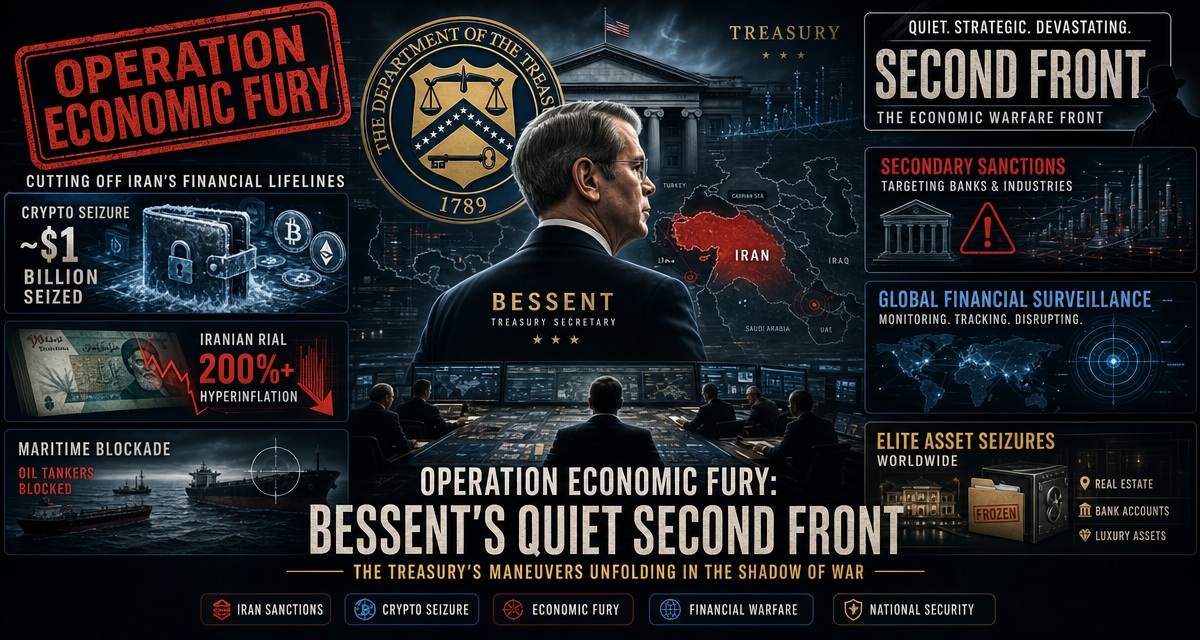
Operation Economic Fury is the U.S. Treasury’s campaign to choke off Iran’s finances using sanctions, frozen assets, and pressure on foreign banks — and in the spring of 2026 it has quietly become a second front in the wider conflict with Iran. While the Middle East war and on-again, off-again ceasefire talks dominate the headlines, Treasury Secretary Scott Bessent has been running this parallel campaign with far less attention. Because U.S. security policy and fiscal policy usually move together, his recent moves are best read not as routine administration but as economic statecraft. This article lays out, based on verified reporting, the Iran sanctions pressure on Chinese banks and Bessent’s parallel push to expand U.S. dollar currency swap lines with allies.
Operation Economic Fury Begins: Warning Letters to Chinese Banks
On April 15, 2026, Bessent told reporters at a White House briefing that the Treasury had sent warning letters to two Chinese banks. Without naming them, he said the U.S. is willing to apply secondary sanctions on any bank found to be holding Iranian money — cutting that bank out of the U.S. financial system and access to the dollar.
The announcement formally unveiled what the Treasury calls Operation Economic Fury. Bessent framed it as “the financial equivalent” of the military campaign: countries and companies buying Iranian oil were told that Iranian money sitting in their banks now exposes them to secondary sanctions. Around the same period, the Treasury reportedly sent similar warning letters to financial institutions in China, Hong Kong, the United Arab Emirates, and Oman.
How Does Iran Evade Oil Sanctions? Shadow Fleets and “Teapot” Refineries
To see why bank pressure matters, it helps to understand the evasion machinery built up over years.
According to Treasury advisories, Iran’s so-called shadow fleet of tankers regularly disables or manipulates location-tracking systems to avoid detection. These vessels conduct ship-to-ship transfers near the Persian Gulf or the Strait of Malacca, where the cargo’s origin is disguised — most often relabeled as “Malaysian blend” crude rather than Iranian.
This laundered oil rarely goes to China’s large state-owned refiners. Instead it flows to small, privately owned independent refineries clustered in Shandong province — the “teapot” refineries. The Treasury estimates China buys roughly 90% of Iran’s oil exports, with teapots handling the bulk. Because they mostly serve China’s domestic market, they carry less exposure to U.S. enforcement and can buy crude at a discount.
Payment is structured to stay invisible too. Dollar transactions must clear through correspondent banks in New York, creating Treasury exposure — so settlement reportedly leans on Chinese yuan or cryptocurrency, often routed through smaller regional banks and Hong Kong shell companies.
How Operation Economic Fury Expanded: The Hengli Refinery Sanctions
On April 24, 2026, the Treasury’s Office of Foreign Assets Control (OFAC) added Hengli Petrochemical (Dalian) Refinery to its sanctions list, describing it as one of Tehran’s most valued customers that had bought billions of dollars in Iranian crude and petroleum products. Hengli is China’s second-largest independent refinery, located in Dalian, Liaoning province. OFAC also sanctioned roughly 40 shipping companies and vessels tied to Iran’s shadow fleet.
This was the fifth Chinese refinery sanctioned since March 2025, following four Shandong-based designations. But sanctions experts caution that hitting individual refineries rarely produces structural change: with so many teapots operating, another can fill the gap when one is sanctioned. That is exactly why some analysts argue financial institutions, not refineries, are the real point of leverage — the logic behind Bessent’s bank warnings.
China pushed back hard. On May 2, 2026, its Ministry of Commerce issued a blocking order declaring it would not recognize or enforce U.S. sanctions against Hengli and four other Chinese companies — the first time China has invoked this mechanism since the rules took effect in 2021.
Separately, the Treasury’s warnings to institutions in Hong Kong, the UAE, and Oman intersect with bipartisan legislation introduced in Congress in April 2025 targeting CCP-linked money laundering, which would investigate whether Hong Kong should be labeled a primary money-laundering concern. As of June 2026, it remains pending legislation rather than enacted law.On April 24, 2026, the Treasury’s Office of Foreign Assets Control (OFAC) added Hengli Petrochemical (Dalian) Refinery to its sanctions list, describing it as one of Tehran’s most valued customers that had bought billions of dollars in Iranian crude and petroleum products. Hengli is China’s second-largest independent refinery, located in Dalian, Liaoning province. OFAC also sanctioned roughly 40 shipping companies and vessels tied to Iran’s shadow fleet.
This was the fifth Chinese refinery sanctioned since March 2025, following four Shandong-based designations. But sanctions experts caution that hitting individual refineries rarely produces structural change: with so many teapots operating, another can fill the gap when one is sanctioned. That is exactly why some analysts argue financial institutions, not refineries, are the real point of leverage — the logic behind Bessent’s bank warnings.
China pushed back hard. On May 2, 2026, its Ministry of Commerce issued a blocking order declaring it would not recognize or enforce U.S. sanctions against Hengli and four other Chinese companies — the first time China has invoked this mechanism since the rules took effect in 2021.
Separately, the Treasury’s warnings to institutions in Hong Kong, the UAE, and Oman intersect with bipartisan legislation introduced in Congress in April 2025 targeting CCP-linked money laundering, which would investigate whether Hong Kong should be labeled a primary money-laundering concern. As of June 2026, it remains pending legislation rather than enacted law.
What Are Currency Swap Lines, and Which Countries Want One?
A second thread in Bessent’s activity is an effort to expand U.S. dollar currency swap lines with allies. On April 22, 2026, he testified to a Senate subcommittee that “many of our Gulf allies have requested swap lines,” and that several Asian allies had as well — remarks that followed President Trump’s confirmation a day earlier that a UAE swap was under consideration.
A currency swap lets a country borrow dollars temporarily, posting its own currency as collateral, repaid once the crisis passes. Today the Federal Reserve maintains permanent swap lines with only five counterparts: Canada, the U.K., Japan, Switzerland, and the European Central Bank. Others — including South Korea, Singapore, and Australia during the 2020 COVID-19 pandemic — have relied on temporary, crisis-specific arrangements.
Bessent framed permanent swap lines as a way to “maintain order in the dollar funding markets,” to prevent disorderly sales of U.S. assets, and to build “new U.S. dollar funding centers in the Gulf and Asia.”
The push can be read two ways: as a move to stop allies from dumping U.S. Treasuries during the Iran crisis, and as a strategic answer to de-dollarization rhetoric from BRICS nations — pulling more countries deeper into dollar-based infrastructure.
It is not without controversy. At the hearing, Senator Chris Van Hollen questioned potential conflicts of interest tied to a UAE official’s investment in the Trump family’s crypto venture and a related stablecoin’s exposure to Binance; Bessent denied any linkage. Technically, swaps usually require Federal Reserve Board approval, though the Treasury can act independently through its Exchange Stabilization Fund — as it did in October 2025 with a $20 billion swap for Argentina, since reportedly repaid in full.
What Does Operation Economic Fury Mean Going Forward?
Bessent’s maneuvers have drawn comparatively little notice amid the Middle East headlines, but they carry real weight for U.S. financial hegemony and the broader Iran strategy. The bank warnings, the teapot refinery sanctions, and the swap-line push all point to Washington pursuing geopolitical goals through financial tools alongside military ones. How far they advance — and whether South Korea or other Asian allies eventually join swap-line talks — remains to be confirmed.
Frequently Asked Questions
What is Operation Economic Fury? It is the U.S. Treasury’s named campaign, unveiled in April 2026, to cripple Iran’s finances by freezing assets, seizing funds, and threatening secondary sanctions on foreign banks and oil buyers that handle Iranian money.
What are secondary sanctions? Secondary sanctions penalize third parties — such as a foreign bank or refinery — for doing business with a sanctioned entity, typically by cutting them off from the U.S. financial system and the dollar.
What is a “teapot” refinery? A small, privately owned independent Chinese refinery, mostly in Shandong province. These buy discounted, sanctions-risked crude and serve China’s domestic market, giving them less exposure to U.S. enforcement.
Why does the U.S. want more currency swap lines? To keep dollar funding markets orderly, discourage allies from dumping U.S. Treasuries during the Iran crisis, and counter de-dollarization by deepening other countries’ reliance on dollar infrastructure.
Prepared from publicly available reporting, including Bloomberg, CNBC, Fox Business, Reuters, Al Jazeera, and official U.S. Treasury (OFAC) releases.