
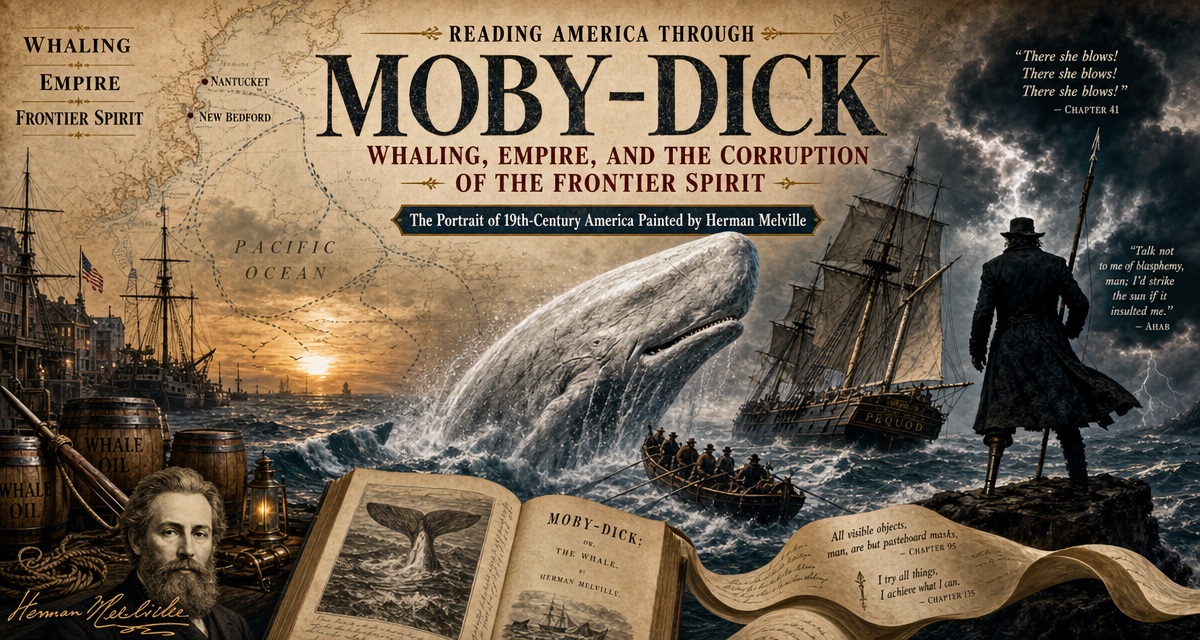
Subtitle: The Portrait of 19th-Century America Painted by Herman Melville
Introduction
When people seek to understand American politics, the books typically recommended are works of political theory — Alexis de Tocqueville’s Democracy in America, or The Federalist Papers. Yet one of the most perceptive portraits of America’s contradictions can be found in Herman Melville’s Moby-Dick. Often celebrated as one of the “Great American Novels,” the book is far more than a whaling adventure story — it is widely read as a compressed portrait of the political, economic, and social fabric of 19th-century America. This article lays out Melville’s life, the plot of Moby-Dick, and the political readings the novel has invited, grounded in verified historical fact.
1. Herman Melville: From Whaling Ship to Novelist
Herman Melville was born in New York City on August 1, 1819, the third child of a prosperous merchant family. However, the family’s import business collapsed in 1830, and his father died in 1832, plunging the family into financial hardship. Throughout his late teens, Melville worked a series of jobs — schoolteacher, bank clerk, farmhand on his uncle’s land — without achieving notable success.
In 1839, at age 20, Melville took his first voyage as a cabin boy aboard the merchant ship St. Lawrence. In January 1841, he signed on with the whaling ship Acushnet, which departed from New Bedford, Massachusetts. This voyage would become the foundation of his literary career.
One detail commonly misremembered deserves correction here. Contrary to a popular version of the story, Melville did not “escape from” a cannibal village. In July 1842, unable to endure the harsh conditions aboard the Acushnet and the brutality of its captain, Melville and a fellow sailor, Toby Greene, deserted the ship and made their way into the interior of Nuku Hiva in the Marquesas Islands, where they lived among the Typee people for roughly a month. Contrary to their fearsome reputation, the Typee reportedly treated Melville hospitably during his stay. He later left the island aboard the Australian whaling ship Lucy Ann.
These experiences became the basis for his first novel, Typee (1846). Notably, the manuscript was initially rejected by American publishers, who doubted the story’s authenticity, and the book was first published in London before an American edition followed. Typee was a commercial success, encouraging Melville to attempt a more ambitious work — which became Moby-Dick (1851). The novel was a commercial failure upon release, and Melville never regained his earlier literary momentum; he spent his later years working as a customs inspector in relative obscurity until his death in 1891. His reputation was posthumously revived, particularly around 1919 — the centennial of his birth — after which Moby-Dick came to be regarded as one of the great achievements of American literature.
2. Plot Summary and the Symbolism of the Opening Line
The plot of Moby-Dick is, at its core, relatively simple: Captain Ahab, consumed by a desire for revenge against the white whale that took his leg, leads his crew on a fatal pursuit, resulting in the destruction of the ship and the death of nearly the entire crew. The lone survivor is the narrator, Ishmael.
The novel opens with “Call me Ishmael” — widely regarded as one of the most famous opening lines in English literature. The name Ishmael originates in the Old Testament, referring to the son born to Abraham and Hagar, his wife Sarah’s maidservant; after Sarah later bore her own son, Isaac, she had Hagar and Ishmael cast out into the wilderness. As a result, the name Ishmael has come to symbolize an outcast or wanderer. The narrator’s choice to identify himself as Ishmael can be read as a deliberate signal that the story will be told from a position on the margins of American society, rather than from its mainstream.
Before setting sail, Ishmael forms a close bond with Queequeg, a Polynesian harpooner. Melville portrays this non-Western character with a degree of human dignity and thoughtfulness that, in the text, exceeds that of many of the Christian characters aboard the ship.
The two board the whaling ship Pequod, commanded by Captain Ahab, who lost a leg in an earlier encounter with the white whale Moby Dick and has since been consumed by a desire for revenge. Ahab nails a gold coin to the mast, promising it to whichever sailor first spots the whale, drawing the crew into his obsessive quest. Only the first mate, Starbuck, voices doubt about Ahab’s fixation, but ultimately the entire crew is swept into it. In the climactic confrontation with Moby Dick, the ship and all hands are lost except Ishmael.
3. The 19th-Century Whaling Industry: “The Oil of Its Time”
To read Moby-Dick through a political lens, it helps to understand the historical significance of the whaling industry in the 19th century. Unlike today’s perception of whaling as a marginal or archaic pursuit, it was, at the time, a critical energy industry. Whale oil had been used as lamp fuel since the 17th century, and demand surged further during the Industrial Revolution as a machine lubricant. It was also widely used in soap, detergents, and cosmetics, while baleen (whalebone) was used in clothing, including women’s corsets. Given this versatility, whale oil is often described as “the oil of its era.”
Britain led the whaling industry through the 17th and 18th centuries, but the United States rose to dominance in the 19th century. Whaling voyages did not return to port until their hold was filled with oil, sometimes requiring three to four years at sea — grueling labor, but also a path to potentially substantial earnings.
The industry declined sharply, however, in the latter half of the 19th century, following Edwin Drake’s 1859 discovery of a commercially viable oil well in Titusville, Pennsylvania. Petroleum proved cheaper and easier to extract than whale oil, and rapidly displaced it as the dominant energy source. Given this historical backdrop, some literary critics interpret the Pequod as a kind of prototype for the multinational corporation searching the globe for energy resources, with Captain Ahab embodying the imperial drive behind that pursuit.
4. The Pequod’s Crew: A Microcosm of American Society
Some interpretations attach symbolic significance to the Pequod’s crew of thirty. At the time Melville was writing Moby-Dick, the United States consisted of 30 states (though by the time the novel was published in 1851, California had already been admitted as the 31st).
The crew itself reflects considerable diversity — Quaker sailors, Black crew members, and others of varied backgrounds appear throughout, arguably mirroring the multiethnic composition of American society at the time. Notably, however, the ship’s command structure — the captain and the mates — is entirely composed of white men, while the most dangerous and physically demanding labor, harpooning and rowing, falls largely to crew members of color. This hierarchy has been read as a quiet commentary on the persistence of racial and class inequality within a society that publicly championed liberty and equality.
5. Manifest Destiny and the Corruption of the Frontier Spirit
Moby-Dick was published in 1851, a period when slavery remained a defining and divisive political issue in American life. During the 1840s and 1850s, the political rhetoric of “Manifest Destiny” gained wide currency in the United States — the idea that westward territorial expansion was not mere ambition, but a divinely ordained national mission. Victory in the Mexican-American War (1846-48) brought California, New Mexico, Arizona, and Texas into U.S. territory, effectively completing the continental phase of westward expansion. American ambitions then turned toward the Pacific; in 1853, a fleet under Commodore Matthew Perry forced open Japan’s ports to American trade.
Against this backdrop, some readings suggest that what troubled Melville was the gradual corruption of the “frontier spirit” — the founding ethos of American settlement — into something closer to imperial appetite. The frontier spirit, in its original form, reflected the drive of individuals to defend their own survival, liberty, and property in the absence of a strong central government or social safety net, pushing westward as an extension of that self-reliance. Melville’s concern, in this reading, was that this once-individualistic ethos was increasingly being repurposed as justification for territorial and resource expansion on a national scale.
Viewed this way, the novel’s central transformation becomes significant: a whaling voyage originally meant to secure a vital resource is hijacked by Captain Ahab and redirected toward an entirely different end — personal vengeance — and the entire crew falls in line with this obsession. A community founded on the ideals of liberty and equality being led to collective ruin by one leader’s destructive fixation can be read as reflecting Melville’s deep unease about the fragility of democratic decision-making.
6. Starbuck and Starbucks: An Interesting Postscript
The name of the Pequod’s first mate, Starbuck, is connected — if indirectly — to the name of Starbucks, the Seattle-founded coffee chain that grew into the world’s largest. The actual story behind this connection, however, differs somewhat from the version commonly repeated.
According to Starbucks’ own corporate account and multiple published reports, when the company was founded in 1971, co-founder Gordon Bowker initially proposed naming it “Pequod,” after the ship in Moby-Dick. His co-founders rejected the idea, reportedly because ordering “a cup of Pequod” sounded awkward (the explanation sometimes repeated — that the name was rejected because the ship sinks at the novel’s end — does not appear to be substantiated by available sources). The team subsequently settled on names beginning with the letter “St,” believing it conveyed strength, and discovered an old mining town called “Starbo” on a map of the Mount Rainier area in Washington State. This recalled the name of the Pequod’s first mate, Starbuck, and the name Starbucks was ultimately chosen.
Conclusion
Moby-Dick is widely regarded not merely as an adventure novel, but as a perceptive portrait of 19th-century America’s energy industry, its racial and class hierarchies, and the gradual transformation of its founding frontier ethos into something closer to imperial ambition. The novel’s central narrative — a hunger for resources curdling into one man’s destructive obsession, and an entire community swept along to ruin in its wake — continues to be read as carrying political resonance more than 170 years after its publication. Given the renewed prominence of competition over energy resources in today’s geopolitics, Moby-Dick remains a classic well worth revisiting.
This article was prepared based on publicly available sources, including PBS American Experience, Encyclopaedia Britannica, Wikipedia, the Nantucket Historical Association, and the official Starbucks corporate website. Certain details (such as the circumstances of Melville’s desertion and the origin of the Starbucks name) have been corrected against official sources where they differed from the original spoken account.Introduction
When people seek to understand American politics, the books typically recommended are works of political theory — Alexis de Tocqueville’s Democracy in America, or The Federalist Papers. Yet one of the most perceptive portraits of America’s contradictions can be found in Herman Melville’s Moby-Dick. Often celebrated as one of the “Great American Novels,” the book is far more than a whaling adventure story — it is widely read as a compressed portrait of the political, economic, and social fabric of 19th-century America. This article lays out Melville’s life, the plot of Moby-Dick, and the political readings the novel has invited, grounded in verified historical fact.
1. Herman Melville: From Whaling Ship to Novelist
Herman Melville was born in New York City on August 1, 1819, the third child of a prosperous merchant family. However, the family’s import business collapsed in 1830, and his father died in 1832, plunging the family into financial hardship. Throughout his late teens, Melville worked a series of jobs — schoolteacher, bank clerk, farmhand on his uncle’s land — without achieving notable success.
In 1839, at age 20, Melville took his first voyage as a cabin boy aboard the merchant ship St. Lawrence. In January 1841, he signed on with the whaling ship Acushnet, which departed from New Bedford, Massachusetts. This voyage would become the foundation of his literary career.
One detail commonly misremembered deserves correction here. Contrary to a popular version of the story, Melville did not “escape from” a cannibal village. In July 1842, unable to endure the harsh conditions aboard the Acushnet and the brutality of its captain, Melville and a fellow sailor, Toby Greene, deserted the ship and made their way into the interior of Nuku Hiva in the Marquesas Islands, where they lived among the Typee people for roughly a month. Contrary to their fearsome reputation, the Typee reportedly treated Melville hospitably during his stay. He later left the island aboard the Australian whaling ship Lucy Ann.
These experiences became the basis for his first novel, Typee (1846). Notably, the manuscript was initially rejected by American publishers, who doubted the story’s authenticity, and the book was first published in London before an American edition followed. Typee was a commercial success, encouraging Melville to attempt a more ambitious work — which became Moby-Dick (1851). The novel was a commercial failure upon release, and Melville never regained his earlier literary momentum; he spent his later years working as a customs inspector in relative obscurity until his death in 1891. His reputation was posthumously revived, particularly around 1919 — the centennial of his birth — after which Moby-Dick came to be regarded as one of the great achievements of American literature.
2. Plot Summary and the Symbolism of the Opening Line
The plot of Moby-Dick is, at its core, relatively simple: Captain Ahab, consumed by a desire for revenge against the white whale that took his leg, leads his crew on a fatal pursuit, resulting in the destruction of the ship and the death of nearly the entire crew. The lone survivor is the narrator, Ishmael.
The novel opens with “Call me Ishmael” — widely regarded as one of the most famous opening lines in English literature. The name Ishmael originates in the Old Testament, referring to the son born to Abraham and Hagar, his wife Sarah’s maidservant; after Sarah later bore her own son, Isaac, she had Hagar and Ishmael cast out into the wilderness. As a result, the name Ishmael has come to symbolize an outcast or wanderer. The narrator’s choice to identify himself as Ishmael can be read as a deliberate signal that the story will be told from a position on the margins of American society, rather than from its mainstream.
Before setting sail, Ishmael forms a close bond with Queequeg, a Polynesian harpooner. Melville portrays this non-Western character with a degree of human dignity and thoughtfulness that, in the text, exceeds that of many of the Christian characters aboard the ship.
The two board the whaling ship Pequod, commanded by Captain Ahab, who lost a leg in an earlier encounter with the white whale Moby Dick and has since been consumed by a desire for revenge. Ahab nails a gold coin to the mast, promising it to whichever sailor first spots the whale, drawing the crew into his obsessive quest. Only the first mate, Starbuck, voices doubt about Ahab’s fixation, but ultimately the entire crew is swept into it. In the climactic confrontation with Moby Dick, the ship and all hands are lost except Ishmael.
3. The 19th-Century Whaling Industry: “The Oil of Its Time”
To read Moby-Dick through a political lens, it helps to understand the historical significance of the whaling industry in the 19th century. Unlike today’s perception of whaling as a marginal or archaic pursuit, it was, at the time, a critical energy industry. Whale oil had been used as lamp fuel since the 17th century, and demand surged further during the Industrial Revolution as a machine lubricant. It was also widely used in soap, detergents, and cosmetics, while baleen (whalebone) was used in clothing, including women’s corsets. Given this versatility, whale oil is often described as “the oil of its era.”
Britain led the whaling industry through the 17th and 18th centuries, but the United States rose to dominance in the 19th century. Whaling voyages did not return to port until their hold was filled with oil, sometimes requiring three to four years at sea — grueling labor, but also a path to potentially substantial earnings.
The industry declined sharply, however, in the latter half of the 19th century, following Edwin Drake’s 1859 discovery of a commercially viable oil well in Titusville, Pennsylvania. Petroleum proved cheaper and easier to extract than whale oil, and rapidly displaced it as the dominant energy source. Given this historical backdrop, some literary critics interpret the Pequod as a kind of prototype for the multinational corporation searching the globe for energy resources, with Captain Ahab embodying the imperial drive behind that pursuit.
4. The Pequod’s Crew: A Microcosm of American Society
Some interpretations attach symbolic significance to the Pequod’s crew of thirty. At the time Melville was writing Moby-Dick, the United States consisted of 30 states (though by the time the novel was published in 1851, California had already been admitted as the 31st).
The crew itself reflects considerable diversity — Quaker sailors, Black crew members, and others of varied backgrounds appear throughout, arguably mirroring the multiethnic composition of American society at the time. Notably, however, the ship’s command structure — the captain and the mates — is entirely composed of white men, while the most dangerous and physically demanding labor, harpooning and rowing, falls largely to crew members of color. This hierarchy has been read as a quiet commentary on the persistence of racial and class inequality within a society that publicly championed liberty and equality.
5. Manifest Destiny and the Corruption of the Frontier Spirit
Moby-Dick was published in 1851, a period when slavery remained a defining and divisive political issue in American life. During the 1840s and 1850s, the political rhetoric of “Manifest Destiny” gained wide currency in the United States — the idea that westward territorial expansion was not mere ambition, but a divinely ordained national mission. Victory in the Mexican-American War (1846-48) brought California, New Mexico, Arizona, and Texas into U.S. territory, effectively completing the continental phase of westward expansion. American ambitions then turned toward the Pacific; in 1853, a fleet under Commodore Matthew Perry forced open Japan’s ports to American trade.
Against this backdrop, some readings suggest that what troubled Melville was the gradual corruption of the “frontier spirit” — the founding ethos of American settlement — into something closer to imperial appetite. The frontier spirit, in its original form, reflected the drive of individuals to defend their own survival, liberty, and property in the absence of a strong central government or social safety net, pushing westward as an extension of that self-reliance. Melville’s concern, in this reading, was that this once-individualistic ethos was increasingly being repurposed as justification for territorial and resource expansion on a national scale.
Viewed this way, the novel’s central transformation becomes significant: a whaling voyage originally meant to secure a vital resource is hijacked by Captain Ahab and redirected toward an entirely different end — personal vengeance — and the entire crew falls in line with this obsession. A community founded on the ideals of liberty and equality being led to collective ruin by one leader’s destructive fixation can be read as reflecting Melville’s deep unease about the fragility of democratic decision-making.
6. Starbuck and Starbucks: An Interesting Postscript
The name of the Pequod’s first mate, Starbuck, is connected — if indirectly — to the name of Starbucks, the Seattle-founded coffee chain that grew into the world’s largest. The actual story behind this connection, however, differs somewhat from the version commonly repeated.
According to Starbucks’ own corporate account and multiple published reports, when the company was founded in 1971, co-founder Gordon Bowker initially proposed naming it “Pequod,” after the ship in Moby-Dick. His co-founders rejected the idea, reportedly because ordering “a cup of Pequod” sounded awkward (the explanation sometimes repeated — that the name was rejected because the ship sinks at the novel’s end — does not appear to be substantiated by available sources). The team subsequently settled on names beginning with the letter “St,” believing it conveyed strength, and discovered an old mining town called “Starbo” on a map of the Mount Rainier area in Washington State. This recalled the name of the Pequod’s first mate, Starbuck, and the name Starbucks was ultimately chosen.
Conclusion
Moby-Dick is widely regarded not merely as an adventure novel, but as a perceptive portrait of 19th-century America’s energy industry, its racial and class hierarchies, and the gradual transformation of its founding frontier ethos into something closer to imperial ambition. The novel’s central narrative — a hunger for resources curdling into one man’s destructive obsession, and an entire community swept along to ruin in its wake — continues to be read as carrying political resonance more than 170 years after its publication. Given the renewed prominence of competition over energy resources in today’s geopolitics, Moby-Dick remains a classic well worth revisiting.
This article was prepared based on publicly available sources, including PBS American Experience, Encyclopaedia Britannica, Wikipedia, the Nantucket Historical Association, and the official Starbucks corporate website.