
How AI and Billionaires Are Racing to Reverse Aging
In 2026, reversing aging stopped being science fiction and entered its first human trial. Here’s what’s real, what’s hype, and why investors are paying attention.
Disclaimer: This article is for informational purposes only and is neither medical nor investment advice. Experimental therapies described here are unproven in humans, and any investment decisions should be made independently after consulting qualified professionals.
For the first time in history, a treatment designed to reverse aging in human cells is being tested in living people. In January 2026, the U.S. FDA cleared the first-ever human trial of cellular reprogramming — a milestone that turns a decades-old theory into a real clinical experiment. Behind it sits a powerful convergence: artificial intelligence compressing decades of drug discovery into months, and some of the world’s richest people pouring billions into the effort. This is the rise of the longevity economy, and whether or not it delivers immortality, it is already reshaping biotech, demographics, and investment.
What Just Happened: The First Human Cellular Reprogramming Trial
In January 2026, Life Biosciences — a biotech co-founded by Harvard genetics professor David Sinclair — received FDA clearance for a Phase 1 trial of a gene therapy called ER-100. It is widely described as the first cellular rejuvenation treatment using partial epigenetic reprogramming ever cleared for human testing.
The trial targets two serious, age-related eye conditions: open-angle glaucoma and non-arteritic anterior ischemic optic neuropathy (NAION), a “stroke of the eye.” Both damage the retinal ganglion cells that carry visual signals to the brain.
The science works like this. Using a viral vector, ER-100 delivers three of the four original Yamanaka factors — OCT4, SOX2, and KLF4, together called OSK — into the eye’s nerve cells. The idea is to reset the cells’ epigenetic “settings” to a younger pattern without erasing their identity. Crucially, the therapy includes a safety switch: the genes activate only when the patient takes the antibiotic doxycycline, and switch off when they stop. The approach builds on Sinclair’s 2020 research that restored vision in blind mice and later succeeded in non-human primates.
It’s worth being precise about claims here. Sinclair has publicly stated that his own biological age has fallen, but such personal age-reversal claims are self-reported and contested among scientists. The verified milestone is the trial itself — not a proven reversal of human aging.
Why Now? AI Is Compressing Decades of Research
Why is a problem that resisted progress for decades suddenly moving? The short answer is AI drug discovery.
Consider the search for “senolytics” — drugs that selectively kill aged, dysfunctional “zombie” cells. In a study published in Nature Aging, researchers (Integrated Biosciences with MIT and the Broad Institute) trained neural networks to predict senolytic activity, then screened a chemical space of more than 800,000 molecules and narrowed it to just three strong candidates. One, known as BRD-K56819078, reduced senescent cells in aged mice. Testing that many compounds by hand would have taken researchers many years; AI did the filtering computationally.
AI has since moved beyond finding drugs to designing the proteins themselves. In 2025, OpenAI and Retro Biosciences unveiled GPT-4b micro, a model specialized for protein engineering. It redesigned the Yamanaka factors and reported roughly a 50x increase in reprogramming efficiency in vitro compared with the standard proteins. For a field where conventionally fewer than 1% of treated cells complete the rejuvenation journey, that is a dramatic jump.
The Billionaire Longevity Race
Follow the money, and the seriousness becomes clear.
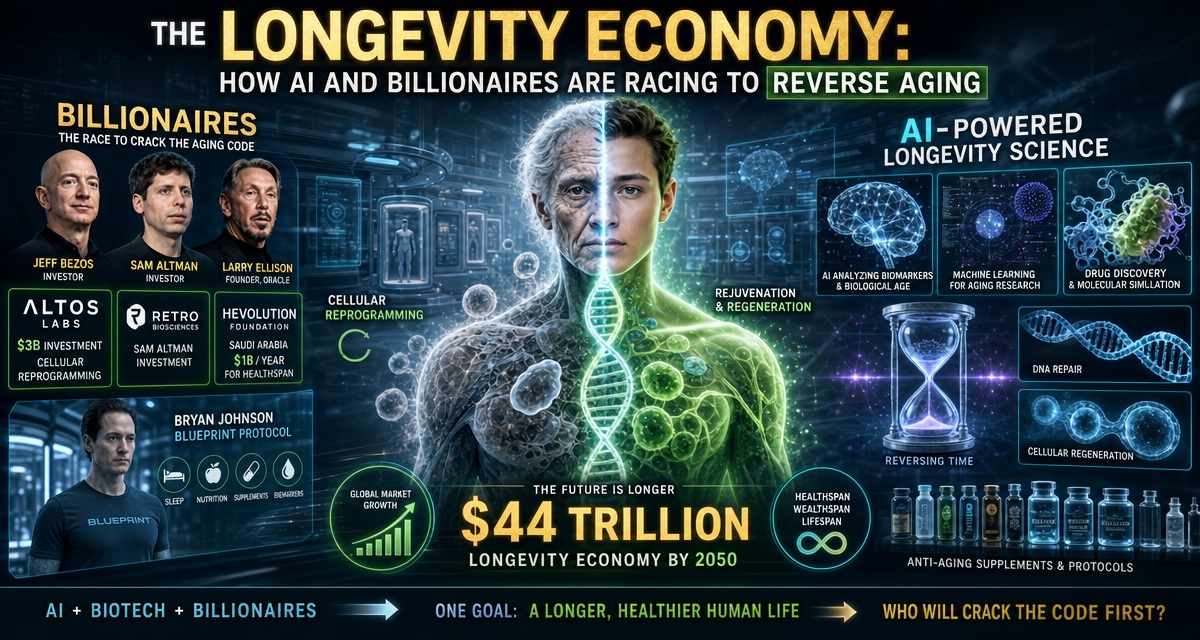
In 2022, Altos Labs launched with a staggering $3 billion — backed by Amazon founder Jeff Bezos and investor Yuri Milner — making it one of the best-funded startups in biotech history. It recruited Nobel laureate Shinya Yamanaka, whose discovery of the reprogramming factors underpins the entire field.
Not to be outdone, OpenAI CEO Sam Altman put $180 million of his own money into Retro Biosciences, which aims to add ten healthy years to human life and is reportedly raising a further $1 billion.
The fascination reaches the highest levels of geopolitics. At a Beijing military parade in September 2025, a hot mic caught Xi Jinping and Vladimir Putin discussing organ replacement, living to 150, and even “immortality” — a surreal exchange later confirmed by Putin to reporters. Whatever one reads into it, the world’s most powerful leaders are talking openly about radical life extension.
The Big Risk: Is Reversing Aging Safe?
Optimism aside, the risks are real — and the biggest is cancer. The same Yamanaka factors that rejuvenate cells can, if over-activated, push cells toward uncontrolled growth and tumor formation. Stem-cell scientist Professor Paul Knoepfler has publicly called this kind of in-vivo reprogramming risky and remains skeptical that it will prove both effective and safe in the human eye.
This is why Life Biosciences built in the doxycycline “on/off” switch and chose the eye — a small, contained, accessible tissue — for the first test, limiting systemic exposure while researchers watch for off-target effects. In a real sense, the field is betting that the line between rejuvenation and cancer can be controlled. Every major technological leap carries risk; the question is whether this one can be made safe enough.
The Longevity Economy and Korea’s Songdo Bio-Cluster
Here is where the science meets macroeconomics. The world is aging fast. South Korea became a “super-aged society” in late 2024, when those 65 and older crossed 20% of the population — among the fastest such transitions on record. An aging world is precisely the market a longevity industry would serve, which is why capital is flowing toward biomanufacturing capacity.
South Korea’s Songdo district in Incheon illustrates the shift. Once a near-empty new town, it now anchors one of the world’s largest biopharmaceutical clusters, led by Samsung Biologics and Celltrion. Songdo’s combined production capacity sits near one million liters today and is projected to reach roughly 2.14 million liters by around 2030–2032 as Samsung, Lotte Biologics, and Celltrion add plants — a scale that has earned it comparisons to a “TSMC of biologics.” For investors tracking megatrends, the longevity economy is less a bet on immortality than on the infrastructure — drug discovery, manufacturing, and demographics — that an aging world will require.
Analysis & Outlook (Opinion)
The following is interpretation, not established fact.
A few forward-looking views are worth flagging as opinion rather than reporting. Some observers argue that regions with lighter regulation could reach human milestones faster, since biotech ultimately requires human testing — a contested ethical claim, not a forecast anyone can verify. Others see Korea’s biomanufacturing base as a structural beneficiary of any longevity boom. And the Xi–Putin exchange has fueled speculation about hidden state-backed research, though that remains conjecture.
What seems reasonable to say is narrower: anti-aging has crossed from animal studies into its first human trial, AI is accelerating the underlying science, and serious money is committed. Whether meaningful results arrive in five years or twenty-five, the direction of travel is now visible. As one futurist famously put it, innovations are dismissed as crazy until the moment they aren’t.
Frequently Asked Questions
Has anyone actually reversed human aging? No. As of 2026, the first human trial of cellular reprogramming (ER-100) has only just begun, and it is primarily a safety study focused on eye disease. No therapy has been proven to reverse aging in humans.
What is cellular reprogramming? A technique that resets a cell’s epigenetic “settings” toward a younger state using proteins called Yamanaka factors, without changing the cell’s DNA. It aims to make old cells behave like younger ones.
Why is AI important for anti-aging research? AI can screen hundreds of thousands of drug candidates computationally and even design improved proteins, compressing work that would take researchers years or decades into months.
How can investors get exposure to the longevity economy? Common routes include biotech and gene-therapy companies, contract manufacturers (CDMOs), and diversified healthcare or thematic funds. All carry significant risk, and this is not investment advice.
Sources: Life Biosciences press releases and FDA IND clearance coverage (Fortune, Longevity.Technology, The Niche/ipscell.com, Lifespan.io); Nature Aging, “Discovering small-molecule senolytics with deep neural networks” (Integrated Biosciences, MIT, Broad Institute); OpenAI × Retro Biosciences “Accelerating life sciences research” (GPT-4b micro); Altos Labs launch coverage (Fierce Biotech, MIT Technology Review); Washington Post / CNN / Al Jazeera (Xi–Putin hot-mic, Sept 2025); Seoul Economic Daily and Samsung Biologics filings (Songdo capacity); Statistics Korea (super-aged society).